8 October 2013

Who is to Blame for the USA Government Shutdown?

This week's Do Now focuses on the government shutdown… And this is the question, Who is to blame for the government shutdown?


At Do Now, they are featuring a great video from PBS NewsHour with lots of excellent classroom resources from NewsHour Extra, the Lowdown, and the New York Times. These resources can help students better understand the complexity of our government.

You can find this week's Do Now here:http://blogs.kqed.org/education/2013/10/04/who-is-to-blame-for-the-government-shutdown/

To respond to the Do Now, you can tweet your response. Be sure to begin your tweet with @KQEDedspace and end it with #DoNowShutdown

4 October 2013

EUROPEAN DAY OF LANGUAGES AT SAN GREGORIO SCHOOL

Year 5 students and their teacher have created an e-Twinning project to work on it along this school year. It is titled:  "Celebrating Together" (You will find more information following the link)

In this project we are working together three european schools:
Our main aim with this project is to work on the calendar of International days. So each month we will have a special celebration of one chosen day. (European Day of Languages, International Day of the Enviroment, Day of Europe....).

The first activity was the celebration of THE EUROPEAN DAY OF LANGUAGES on the 26th  September 2013. Here you can see the activity we did at San Gregorio School and which the teacher published in the own blogs: 
This has been the final product of the activity at San Gregorio School. 


Year 5A


Year 5B


This is the final product of the celebration which took place at  Holy Trinity School in Inglaterra:


And this is the final product of the celebration which took place at Polish school:


CONGRATULATIONS TO ALL OF YOU. 
IT'S A MARVELLOUS JOB!!


LET'S VISIT OUR WEBSITE FOR MORE INFORMATION ABOUT THE e-Twinning PROJECT.
"Celebrating together"


Julián Sanz Mamolar (@julisanzmamolar/Mi primer año en RedXXI)
Javier Ramos Sancha (@javiramossancha/ SGAguilar Javier Ramos)

30 September 2013

48 stories for English Tenses


Today we want to show you a good recourse if you are learning or working grammar topics.

It can be very useful for teachers and students because can practice all 12 English tenses (simple present, present progressive, simple past, future perfect...) as well as reading, writing, sentence structure and comprehension. 


It's an easy way to learn and teach grammar through stories.
Here it is:
  • 4 illustrated stories for each of the 12 tenses (for example, 4 stories to practice the present perfect, 4 stories to practice the future continuous, etc.)
  • 48 stories altogether
  • Short and easy stories
  • Each story comes with a set of exercises and an answer key
  • Available online, and as downloadable/printable worksheets
  • Absolutely free to use.


Thanks to Heidi J Bai one of the teachers behind the web http://www.really-learn-english.com/, sharing this work with us.


24 September 2013

Comenius Visit to Poland

Here I want to show you a video summary of the last visit we celebrate the last school year to conclude our Comenius Project: Travelbroadens the mind. Let’s travel together!

We were hosted by families of our partners schools: Zespół Szkolno-Przedszkolny nr 3 im.Jana Pawła II in Ribnyck (Poland). In this visit we were six 10-year-old students and two teachers. We were really happy because with this visit our students changed their mind and knowing another culture they really enjoyed. What at the begging was just OK at the end it was amazing for them.


Here you can see some video summaries about that visit:


Following this link you can have a look to all the presentations the students did about the visit.
We hope you like it.
Javier Ramos Sancha
@javiramossancha

23 September 2013

Is Health Care a Human Right?

This week's Do Now asks students if they think that health care is a basic human right and if all people should, regardless of wealth, have access to quality health care.  This issue is back in the news since open enrollment in the Patient Protection and Affordable Care Act (ACA) marketplace, popularly known as Obamacare, begins October 1, meaning that people will soon be able to sign up for government-subsidized health insurance programs. The House GOP has also launched a shutdown battle by voting to defund Obamacare.

Here's the link to the Do Now:

http://blogs.kqed.org/education/2013/09/20/is-health-care-a-human-right/


whitehouse.gov

To respond to the Do Now, you can comment below or tweet your response. Be sure to begin your tweet with @KQEDEdspace and end it with #DoNowACA

19 September 2013

Create a Google style classroom newspaper

We are sure all of you have some time used various tools to create digital newspapers and paper ones, too.
Our first tip for teachers focuses on creating a newspaper using Google Docs, a very simple tool which allows us to easily design attractive, collaborative and successful papers written by any grade reporter.

Steps:
1. Explain what Google Docs is if you are about to first use it with your ESL students, as well as what it is for and how it can be a nice writing collaborative tool. Students are bound to grasp everything quickly and it should not take over an hour to get them going.
2. Choose an adequate template to design the newspaper: Student newspaper is a good one.
3. Let students pick up their roles as reporters and decide on the newspaper sections, number of issues published, frequency, and so on.
4. Allow some time for students to gather information, search for pictures, draft their articles and contribute to the newspaper. Do not forget that it is important to respect licences and quote sources for images and any other multimedia elements that you may include in your publication.
5. Arrange self-assessment, peer to peer assessment and finally your own assessment. Rubrics are a nice means for the three kinds of assessment. You might like to use Rubistar to compile your own rubrics.
6. If needed, do some final editing, download it as a pdf file and hand it out to everybody at school. Youpublisher also provides you with the chance to have a digital publication.

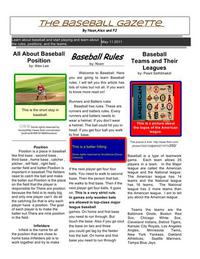
The final output might look something like the example below, an idea by Laura Chesebro: The Baseball Gazette.


Ready to put this tip into practice in class?
Why don't you compile your own classroom newspaper? We'd love to gather your newspapers here, all your contributions are welcome! 
Just make a comment here or mail us with the output you designed with your students after having followed the steps of this tip.
Good luck!


18 September 2013

Talk like a Pirate Day


Maybe, this doesn't say much to anybody in a non-British context, but it can be a good opportunity for English teachers of any level to try and play pirates with their students as they learn  new vocabulary and expressions, listen, talk, write... Let's have a look at some of these possibilities: 
- The official TLAP site (http://www.talklikeapirate.com/) has lots of activities like a pirate's personality test or a Pirate's Name Generator, but as it is designed for native speakers, it  might be difficult or not very suitable for beginners. 
- The Pirates Theme Page of Enchanted Learning on the other hand, has plenty of crafts, activities, word puzzles, etc. designed for the young ones; and although membership (some 17€/year) is required to download and print the original worksheets, you can surf and find ideas to adapt yourself to your specific needs. 
- There's also a Facebook Page for the event and a TLAP Wiki with easy tips to celebrate a funny TLAP Day (don't miss the video about how to change normal words and expressions  into 'pirate' language)
- Last but not least, here comes the music. Nobody would think of a real pirate party without a song. This may be a good opportunity to learn and sing the famous Drunken Sailor, either with the original Irish rhythm...


...or, why not, in the Spanish version by "Celtas Cortos" :-)


One way or another, Enjoy TLAP Day!!!...  and tell us!!