Showing posts with label URJC. Show all posts

29 April 2016

Are you ready to meet TIC?

We are Celia González, María Lainez, Cristina Risueño, Estrella García and Gonzalo Montón and we are students at the URJC university in the Master of Bilingual Education. We would like to share a couple of challenges for CLIL Primary students with you.

For this group task, we had to become both writers and film directors! We were requested to create a clip but, first of all, we had to plan what it would be about. Therefore we started to create a storyboard with our main ideas. As the topics we were working with for our CLIL e-project were about the Earth, we decided to create a character based on the universe. What could be better than an alien? Everybody wants to know about life from outer space! That’s how TIC was born, our main character. Can you guess why he is called TIC?

To create our storyboard we chose the web tool Storyboard That. Since the moment we started to use this tool, we were surprised at how amazing the pictures were: backgrounds, characters and different shapes, which allow you to create exactly what you want. What we liked best was the possibility of modifying the position of the main character, which makes the story more real.

However, while using the tool, we discovered that a standard account doesn’t allow you to create a board with more than six scenes. This is why we had to shorten the story. It was not a problem because the final clip will include the whole story. This storyboard is a guideline for the video challenge and it is meant to be a tale the teacher could tell their students at class.

Here you are our storyboard! Are you ready to meet TIC?


Made with Storyboard That

From the storyboard, we brought TIC to live! First, if you want to film a movie you need to write a script so we became writers! Our clip was divided into eleven scenes in which our alien would travel through the Solar System to discover the magic planet. TIC was dying to find it out!

Second, we started to film the scenes, but… We needed an actor! Gonzalo, @gonzaalo10, became TIC thanks to our make-up team!

Then, we were ready to record the video challenge. For this purpose we decided to use the chroma key technique. By using Camtasia and this technique, we could substitute the green background for a picture of our choice. Regarding Camtasia, it seems quite difficult to use at rhe very beginning. However, after practicing with it for a while we discovered all its possibilities. We downloaded the free version with a free trial for 30 days. Thanks to Camtasia, we have learned how to use chroma key and how to organize the video clips, the pictures and the audios in order to get the final video. The only problem we didn´t like about this tool was the fact that, because of the free version, a watermark appeared in our video and the quality of it decreased.

Despite this little problem, the result was fantastic! We created a video in which TIC travels through the Solar system and discovers the Earth and its layers. TIC also has doubts and makes questions during the video in order to encourage participation in our pupils. The teacher could stop the video whenever TIC makes one question to let the pupils answer him. This video can be used to introduce a topic, so the teacher can know about their prior knowledge, or to make a review at the end of the topic.


Hope you enjoy it!

27 April 2016

Video challenge to learn about animals

Today, a group of students from the Universidad Rey Juan Carlos studying a Master’s Degree in Bilingual Education, have created a comic using Storyboard That and a video using Sony Vegas Pro to explain an activity that they have included in a collaborative e-project they are currently designing for their Master's Degree.

The authors are:

Guillermo Lagarejos @GLHmaster                    
Marina Goizueta @GoizuetaMarina
Teresa Martín @Teresa_md                            
Laura Pérez @LauritaPerz
María Collado @Maria_collado92
Sara Rodríguez @SaritaSar0


Made with Storyboard That


The aim of their video is to motivate learners to do an activity while and after their visit to Faunia. As their e-project is about animals, they decided that a school trip to Faunia could be a fun way to keep working on this topic while children learn more about it.

In the video they briefly explain how to carry out a research on the animals’ topic in which children will investigate, take notes and look for specific information about the characteristics of vertebrate animals. Then they would prepare a presentation using Genially to share their experience and learning to the rest of the class.

Before recording themselves, they have been thinking on the organization of the video, roles and what to say. To have a clear idea of what they wanted to do, they used StoryboardThat, an online tool in which you can create an storyboard, similar to a comic, to create a story or present an activity to children, for instance.

In this case they have used this tool to describe their video, which consists of explaining an activity to children about visiting Faunia. This tool has been very easy to use and it is great for students as it is engaging and attractive for them. It could be used in class to explain an activity or develop their imagination by creating stories.

The comic that they have created is divided into different frames:

-          Presentation of the activity

-          Explanation of what students have to do in Faunia

-          Tools that they are going to use in Faunia

-          Students in Faunia

-          Explanation of the activity after the trip

-          Final comments

25 April 2016

Learning about the body & senses with ICT

Name of the Reporters: Raquel Diez, Celia Lancharro, Patricia Madrueño and Natalia Martínez
Name of school: Universidad Rey Juan Carlos

We would like to introduce our CLIL e-project, which is called Learning about Body and senses with ICT. It is a collaborative e-project carried out by our team in the Master’s Degree in Bilingual Education at URJC. It is aimed to be introduced to 3rd graders of Primary Education.


We were asked to make a video showing our e-project by firstly making a planning of it. In order to create our video planning, we decided to use the StoryboardThat webtool, since it is a very visual but simple resource to make comics and it would help us have a clear idea about what to do in our e-project video.

Our e-project proposal is that children create a poster using Canva. In this sense, the steps in the CLIL challenge which students will have to follow are:

  1. Make groups of 3 people in order to work cooperatively. 
  2. Each group will have to search for information on the Internet about the body and senses. They will also have to select and collect this information in order to create the poster.
  3. They will have to create a Canva account (one per group).
  4. Using the information they’ve found on the Internet, they will make a poster including visual support as images or videos.
  5. Finally, each group will share their creation on the social network (twitter, pinterest, facebook, the school blog…)


Here you have our final Storyboard:

Made with Storyboard That

And if you prefer, you can click on the following link to see it: https://www.storyboardthat.com/storyboards/93_nat/the-senses

After creating our storyboard we could start recording our e-project video.  The storyboard helped us to have a guideline to follow.

In this video we show our CLIL e-project about the body and the senses. We wanted to create an original and engaging clip. For this reason, we have recorded it as if we were students in a classroom carrying the e-project out. We have used a smartphone to record our videoclip, and then, we chose Windows Movie Maker to create and edit the final video.

Have a look at our e-project video:


Here you can meet us and learn more about our team on:

Raquel Diez Alonso → Twitter: @raqueldial & e-Portfolio: learningbydoingwithict.blogspost.com.es
Celia Lancharro Román → Twitter: @celialancharro & e-Portfolio: http://ictandbilingualeducation.blogspot.com.es/
Patricia Madrueño Sierro → Twitter: @patimasie & e-Porfolio: patimasie.tumblr.com
Natalia Martínez Domínguez → Twitter: @NataliaMD93 & e-Portfolio: http://motivationintheclassroom.blogspot.com.es/


20 April 2016

History Video Challenge for CLIL students

Today we are sharing a CLIL activity for Primary students, designed by a team of students at the Rey Juan Carlos University in Madrid.

They are working right now in a collaborative e-project to teach History in a different way, and have created a video challenge.

As you know, when you want to record a video it is really essential to plan everything in advance. An easy way to do it is by storyboarding your video, which means planning every scene to have it ready for the recording moment. They have used StoryBoard That to create this amazing outline. As you can see, they have included the characters, the backgrounds (they will use a croma when recording to add them by video editing) and everything they were going to say.

StoryBoard That is easy to use and you can create 6 scenes for free where you can add characters, bakgrounds and edit them with a great variety of designs.


Made with Storyboard That

Having made this outline, they were ready to record their video. As you can see they planned to dress up as different people in different times in History, So there they went!


In the video they present a new challenge to their children: they will have to crceate their own comic about History!

They think that this is an amazing way of teaching History in a different way. Children will be more motivated and focused on their task since they will have to use a online web tool called Pixton, which allows people to create online comics for free.

And here is their amazing production:


18 April 2016

European Geography

Today we are sharing the work of a group of Pre-Service Teachers at URJC who have let us know of their e-project based on video production.


They are Víctor, Inma, Ana, Lola, Natalia and Elena, students of the Master in Bilingual education in Primary School at Rey Juan Carlos University. This week they have been working in groups and they have done different activities in their ICT class.

This is the description of their own learning process, in first person, as Ana, their spokeswoman, has literally introduced it:

'First of all let me explain to you that all of us created a CLIL-e-project. Once we had it, we were allocated in different groups according to the topic. In this way, our group is about Geography.

Even though our topic was Geography we had really different themes within this topic so we thought about one common learning outcome and we all agreed that it could be “to learn about the physical and political features and some of the most distinguishing representations of the European countries”.  The  final activity of our project consists of presenting the candidature of one European country.  We would divide our students in pairs  and will assign them a European country to work on. Then, students would have to  investigate about it (about the weather, animals, mountain ranges, rivers…)  and finally create an Infographic, (you can see an example here: https://magic.piktochart.com/output/12668493-norway#.Vwd4fexYnM0.blogger)

So we created our story board using StoryboardThat to express the process that we will follow to explain this activity to our students.

We would like to recommend that you use this fantastic tool if you have the chance since it offers many possibilities. You can choose the length by choosing the number of vignettes. You can choose among a wide range of scenes (you can choose among the typical ones such as the school scenes but you can also choose castles, islands...), characters (you can even change their emotions and create angry and sad characters.) and text tables. Therefore, you can adapt your stories for any purpose. For instance, we could use it in our class to introduce one topic in a more visual and fun way.

However, we found out some things that from our humble opinion could be improved. For instance, we did not like the fact that the work you do is not automatically saved. Therefore, you have to be saving it all the time. Even though the page reminds you to save, it would be fantastic if it could be done automatically.

It would also be very nice if SoryboardThat could have an option to record voices, that would be awesome. Our students could practice their speaking skills, writing, computer skills and also their creativity when creating their comic!

Furthermore, students could create their own stories about any topic of the curriculum (for example we could ask them to create a story in which they had to include information about Egypt or any topic they are studying). In this way not only would they work one subjects but also they would put in practice and would improve their ICT skills!

Of course these kinds of tools are fantastic to communicate with children with special needs. Sometimes, they find it difficult to understand abstract languages and concepts, and this tool makes  the process of communication easier. We can also use this comic for the routines: think about first grade of Primary School, at the beginning they find it difficult to get used to the routines of Primary, we could help them to remember them all by creating comics around the class (For example, before going to the playground take your snack, make a line and keep in silence).


Here you are the link of our final comic: https://www.storyboardthat.com/storyboards/elena_ictclil/the-olympic-games2


Made with Storyboard That

Once we created our Story Board we started working in our video.  Thanks to the Storyboard that we had created previously we did not have any problem with the video as we already knew what we were going to say. To make the video we used IMovie with the support of an Ipad. We would really like to recommend that you use this tool as well  if you have the opportunity because it is really easy and intuitive. You can do many things with it, for example adding music to your videos, images, cropping your videos. Definitely this tool was fantastic to accomplish  this challenge! As it is so easy to use you can even use it with your children in your class! Just imagine the results presenting their candidatures for the Olympic Games.... they would enjoy this activity as much as we did and they would be practising their speaking skills and learning new things without realising!'

You can see their video here:


30 June 2015

Is Minecraft your planet?


Would you like to create your own planet and use Minecraft for that purpose in your CLIL Primary lessons?
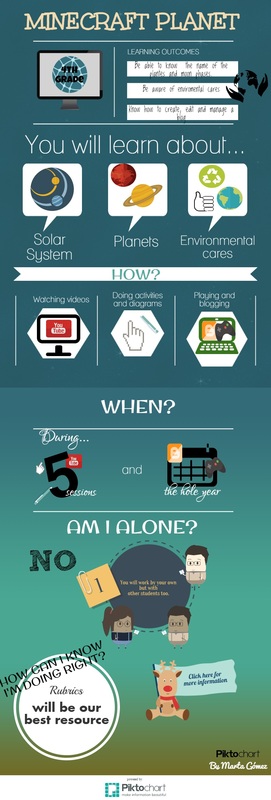
Then, check MineCraft Planet, the e-publication that Marta Gómez that has designed along her Master's Degree Module on The Use of ICT and Web Resources for Primary Bilingual Education at University Rey Juan Carlos in Madrid.

If you are a 9 or 10-year old kid and would like to investigate on planets in English, you are bound to find engaging learning missions that you are bound to enjoy, such as video and audio challenges, Minecraft games, collaborative presentations and so forth.


But of course, and as the e-publication infographic advertises, you are not alone. You are guided by the curated tools that Marta Gómez has gathered for you in the list below:


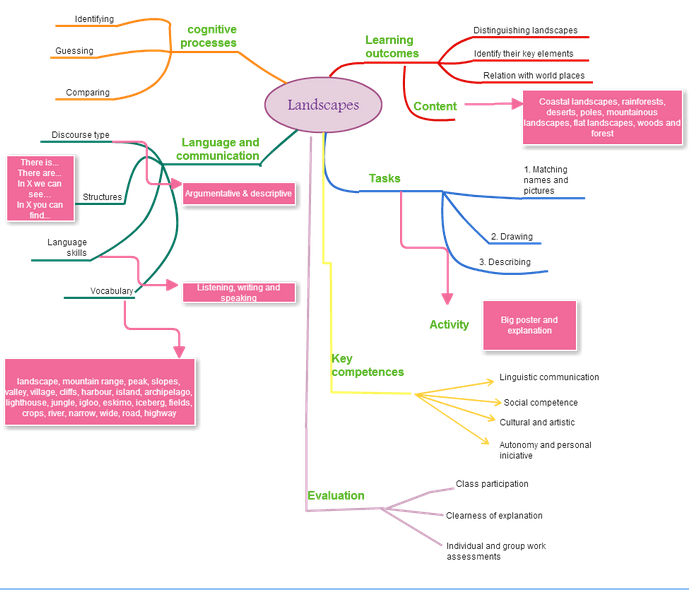
And, if you are a Science CLIL Primary teacher, you have your section too at this e-publication, outlined in a CLIL template as well as a mindmap, so that you can have a quick look about what goals can be achieved by surfing Marta's digital artifacts, what skills and competencies can be accomplished and what learning outcomes are to be produced.

Stay tuned for news about this project based learning oriented CLIL e-publication and find it all about how Marta has also become a connected teacher while turning her ideas into a real digital resource for CLIL learners.


29 June 2015

Little Geniuses of The Renaissance

Silvia Plana is kindly sharing her brand new e-publication for CLIL Primary learners: Little Geniuses of The Renaissance.

The site is intended to be used in Arts and Crafts lessons with 11-year olds and it has taken Silvia three months to turn the skeleton and mindmap of her first draft into a real digital publication. She has risen up to the challenge while completing her Master's Degree Mondule on The Use of ICT and Web Resources for Primary Bilingual Education at University Rey Juan Carlos in Madrid.

The best way to find out what this artistic e-publication has to offer both CLIL teachers and students is to take a glimpse at the infographic below, which Silvia designed as her personal contribution to the collaborative @infoEDUgrafias educational project.


The adventure through the lives of child geniuses starts with Leonardo, portrayed as a kid in neat storyboard, which later in the e-publication becomes a video challenge.


Once the main character of the e-publication is introduced, Silvia leaves it to the learners to investigate and autonomously learn more about Da Vinci, thanks to an animated clip:


MichaelAngelo is also a character in this CLIL resource, introduced as a friend of Da Vinci's and as means to challenge learners to become sculptors for a day.


You are all invited to surf this CLIL e-publication and let Silvia know what you think, after listening to her own reflections after having had completed her learning journey:


25 June 2015

Let's make learning fun


Here you are the e-publication Jimena Acevedo has recently released for Primary CLIL learners after having completed her Master's Degree Module on  The Use of ICT and Web Resources for Primary Bilingual Education at University Rey Juan Carlos in Madrid: Let's make learning fun!

The overview of this digital resource is clarifyingly mindmapped, so you can check to view the goals, key competencies, scaffolding and much more the author has envisaged from the very beginning.


The author has first thought of visual elements and principles, and in order to be able to think about that and put it into practice in her own e-publication, she has previously searched for inspiration in other ebooks, which she has evaluated:


After this prior step, and after curating and gathering some CLIL resources, tools and apps, to be included in her outcome, Jimena has dived into the difficult adventure of creating learning missions for her learners and any other kids interested in learning about landscapes and living things in English. She has eventually come up with audio and video challenges, storyboards and some other artifacts that you are all invited to surf now.

Finally, and after three months of solid work with ICT and web resources, Jimena has disseminated her work on a worldwide live session at WizIQ, co-presenting for Moodle MOOC 6, and has reflected about her own learning journey when creating her first e-publication ever.

24 June 2015

Landscapes around the world


Cristina Fradejas is a CLIL Primary Education teacher who has just finished her Master's Degree Module on The Use of ICT and Web Resources for Primary Bilingual Education at University Rey Juan Carlos in Madrid.

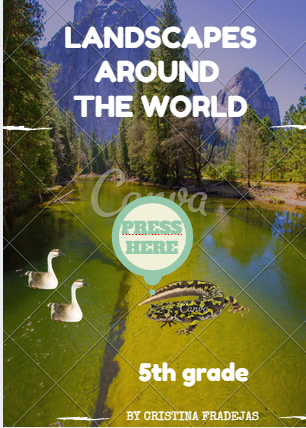
All along the aforesaid module, she has been working on crafting a CLIL e-publication for Primary CLIL learners, which she is sharing now with all of us: Landscapes around the world. This open educational resource is aimed at ten-year-old students to learn Science through projects. Its main objective is to allow students to master information related to landscapes and their main characteristics, and in order for them to be able to accomplish that, Cristina has created a whole area for students to go on learning missions with which they work various skills and compentencies.

Check the e-publication infographic and/or its mindmap for an overview:


Some of the most engaging proposals in this e-publication are her challenge storyboard to foster students' competence on investigation and autonomous learning,


her video clip posing a problem for learners to help solve,


her cooperative slideshow with her peer Aser Santos,


or her playlist to encourage speaking skills.


Cristina is aware of the importance of being a connected teacher so that to spread connections among her students too, and that is the reason why she has contributed to collaborative projects, events and educational initiatives which have allowed her to be aware of innovative trends, establish relationships with other educators worldwide and open her teaching to a community of professional lifelong peers.


23 June 2015

The 7 Continents


A very engaging title for a CLIL e-publication for young Primary Education learners to learn and investigate about Geography in English. This is how Rubén M. Ferrero has named the student-centered digital open resource he has designed along the Master's Degree Module on The Use of ICT and Web Resources for Primary Bilingual Education he has just completed at University Rey Juan Carlos in Madrid.

Meet Rubén by viewing his 321 Introduction and then have a look at the e-publication skeleton and infographic for a better understanding of his goals and aims at designing it and how to apply it in bilingual lessons.


Once inside, I invite you to explore the challenges Rubén is proposing the learners to rise up to, led by the main character of the e-publication, that is, Alan Walker, whom you can meet thanks to a storyboard, and later brainstorm with him about the knowledge gained through autonomous investigation.


But, better than reading about it all, why not listening to the author himself and his self-reflection on the e-publication? There you go!

22 June 2015

Elizabeth of Austria


The mysterious augmented image above is actually the cover of the e-publication Lourdes de los Mares has designed for CLIL Primary Bilingual learners along the Master's Degree Module on The Use of ICT and Web Resources for Primary Bilingual Education she has just completed at University Rey Juan Carlos in Madrid.

Unveil what the cover is hiding with your Aurasma app; follow LourdesRosaDelmares and, as the author suggests, delve into the story of an intriguing puzzling historical lady as Elizabeth of Austria was at her time.

As any connected innovative teacher nowadays, before jumping into designing and developing an open educational resource, Lourdes analysed what she needed, the aims and goals of her artifact, investigated, searched for information, filtered and curated what best matched her ideas, and in order to gather all the resources, tips and inspiration, she created a nice list of digital resources for the digital classroom, which she would later incorporate to her epublication.
Her 'Elizabeth of Austria - The shadow of loneliness' is full of resources and learning mission for 12-year-old learners, who are challenged with video and audio challenges, collaborative presentations and connected adventures so that they understand the life of this sad-looking Queen. Besides, the author herself has gone on a hands-on approach and created a student-centered e-publication with lots of examples and guidelines produced by Lourdes herself, such as Voki Avatars, Powtoon animated clips and so forth, which work as scaffolding from a CLIL viewpoint. Just check the Students section in the e-publication and surf around.


Teachers are not forgotten in this e-publication, of course, and Lourdes has a whole area focused on various inspiring collaborative projects and online events worldwide, where she has participated herself and has found inspiration, too, so she is sharing them now in case any other teacher might also find them useful.

You are all invited to know Elizabeth of Austria better now, and from a somewhat different viewpoint to the usual historical one, as well as to meet Lourdes and view how she has understood her journey across this project based learning adventure.


18 June 2015

Discovering new planets

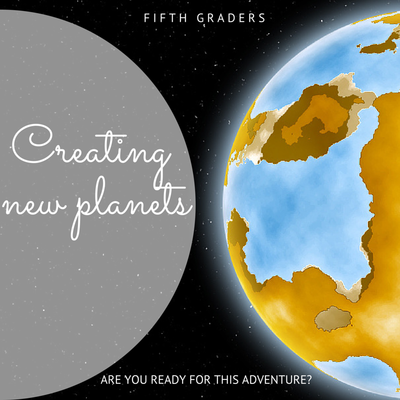
 If you are into rockets and flying your imagination away, the CLIL e-publication by Estefanía Blanco is definately for you. Estefanía has been working on her Weebly for three months, while attending her Master's Degree Module on The Use of ICT and Web Resources for Primary Bilingual Education at University Rey Juan Carlos in Madrid and becoming a connected teacher who takes part in collaborative projects worldwide.

Her CLIL e-publication is aimed at fifth year bilingual learners to investigate on planets in such a way that in the end, they will be able to create an amazing new planet themselves! 

If you are a student and are ready to launch this rocket, check the Students area and rise up to the challenge Estefanía is proposing. Begin unveiling the Augmented Reality mystery just with your mobile device, the Aurasma app and following eblancoh channel there.


Or, if you are more into video missions and mixing planets, Art and healthy life, that is, a mad combination of collaborative learning paths, meet Pedro and dream along:


But, in order to create your amazing planet and keep it friendly enough for others to want and go to live in it, one should start by becoming aware of how to live clean, and that is what Estefanía is teaching you to do, in collaboration with her teacher peer Nora Lomas, through a cute story narrated with Storybird: 'Living in Cleanly by StefiNora'.

And, of course, being able to guess is a great way to learn, too, and that is why Estefanía is sending you on an audio challenge that fosters both listening skills and cuorisity for learning more:


No matter which challenges you choose to rise up to, you are bound to look forward to creating that planet of yours, and present it to your classmates, as in this short sample clip the author has designed to present her own ideal new planet looking for inhabitants.


Of course, you are not alone in this rocking mission. Resources, tips and lots of help have been envisaged to guide you in the search of your new planet, such as the neat webmix Estefanía has compiled to make your creative life easier.


And, if you are a CLIL Primary teacher, the e-publication also has an area for you, the Teachers' section where you are going to find the skeleton and the mindmap of 'Discovering new Planets', together with the author's experience on the process of creating and the sources she has got inspiration from.


17 June 2015

Cultivating Knowledge - Let the information about plants grow


This is the CLIL e-publication by Ana Morenoa Primary Bilingual teacher who has just finished her Master's Degree Module on The Use of ICT and Web Resources for Primary Bilingual Education at University Rey Juan Carlos in Madrid.

Her interesting CLIL site is aimed to teach plants to third year Primary Bilingual learners, as well as aspects related to that area of learning, intended for the kids to learn by doing their own e-projects. The overview of it all is mindmapped below:


In order to create an open e-book for her own future students, she first evaluated some ebooks, already published and shared by in-service teachers, and jumped to her own conclusions as regards visual principles and various other items related to digital publications of the kind, which she gathered in a flyer where she also reflected about the steps taken in this first stage of  her project:

On her journey across the design of her first CLIL e-publication, she has also become a connected educator herself and has taken part in a range of collaborative projects worldwide, starting with the @infoEdugrafias project, where she contributed with an infographic of the draft of her e-book to be, using Canva, an online tool which Ana undoubtedly is in love with.


Besides, she has shared her own dreams and interpreted other kids' dreams, thanks to #twima2 project, which gave her the chance to be in touch with kids from different parts of the world, get a glimpse of their wishes and practise writing skills in English too, all of it with the purpose of getting acquainted with active methodologies and being able to put them into practice in her own lessons in the very near future.

And, while surfing along all the inspiring tips and ideas, and almost unaware of it, she became a content curator, learned how to search, filter and select information, and started her webmix of resources ready to be used when designing activities for her e-publication and ready for any other teacher to use them too.

Once the prior maybe more exahusting work was done, the resources were gathered, the licence for the e-publication ready, and the digital site chosen, there came Ana's most creative side, willing to jump into the production of digital learning missions and artifacts, and so she came up with cute ideas such as a storyboard for learners to understand pollination better,


Create a Copy | View Larger

the follow-up video challenge,


the audio mysteries to be discovered behind these Qr Codes,


or the collaborative poster designed to cross over several of her colleagues' CLIL e-publications and finding common areas to teach in cooperation.


Her creativity and talent for teaching plants is also highlighted with the fun neat comic Ana has invented with Chogger for teaching the life cycle of a plant:


Finally, she has also been able to spread the word about her CLIL digital outcome, again connecting with other educators thanks to ICT, when together with the whole group of peer pre-service teachers, she was invited to co-present at Moodle MOOC 6, an open free online event held at WizIQ.

And, being aware herself of the importance of self-evaluation, assessment and reflection on one's own way of learning, Ana has concluded her open digital publication with a clip that illustrates all the way she has come from early February, when this adventure started, until late May, when it was all on air and ready for your comments and feedback, which are more than welcome!


10 June 2015

Creative Writing

This is the CLIL e-publication Montserrat Mejía has designed for young bilingual learners along her Master's Degree Module on The Use of ICT and Web Resources for Primary Bilingual Education at URJC from February to May 2015.

The e-publication is intended for young learners to develop their writing skills while accomplishing challenges and crafting digital missions.

Montserrat Mejía has been inspired by the EVO Crafting the ePerfect Textbook 2015 session, which has been her starting point to evaluate publications of the kind and dive into visual principles.

Later on, she mindmapped her e-publication and decided on blogging as her personal showcase for the final outcome, while she was curating resources to be included in her challenges and missions.

At the same time, she connected with other educators worldwide and took part in several international collaborative projects, which were also a source of inspiration for her hands-on practice at designing her open educational digital blog.

Her experience at the Spring Blog Festival 2015,  the Twima 2 Project and Moodle MOOC 6 are highlighted by the author herself as outstanding chances to meet teaching peers and get to know what is on in the elearning educational world.

You are all welcome to surf her final outcome, navigage along the various challenges she is proposing as well as viewing and listening to her reflections on her own learning process.


The story of a young writer by montsem_88 on GoAnimate

8 June 2015

Chef of Volume live

Check this awesome CLIL e-publication for eight year old learners by Marta Plaza, a Primary Bilingual teacher who has just finished her Master's Degree Module on The Use of ICT and Web Resources for Primary Bilingual Education at University Rey Juan Carlos in Madrid.

Marta is providing full objectives, learning outcomes and what visitors to her Chef of Volume might expect, in a simple but visually engaging infographic which she has designed for the @infoEdugrafias collaborative blogging project.


Besides, if you are not into deep reading but would rather have a quick glimpse at what Chef of Volume has to offer you, the author has also mindmapped her whole e-publication for a quick overview:


My advice is that you land on the e-publication augmented cover and meet cute Holly and Phoebe, who are willing to unveil the surprises Chef of Volume is hiding behind the wide range of learning missions CLIL young learners will love completing.

This open educational resource is inspired by a task where students have to make sandwiches of different geometric shapes. The goal is that CLIL young kids learn about some mathematic content throughout a cross curricular approach. Its main objective is to make students make a difference between the concepts of area and volume while doing web searches in small groups and using online tools for presentations and a video creation.

And, if you are a CLIL teacher yourself, you might also find it useful for your own lessons. Check the e-publication skeleton and decide for yourself. Morevover, if you are into open e-publications, you may find Marta's evaluation of digital ebooks interesting, as it was her prior step to designing her own showcase, inspired by what participants in the ebookEVO 2015 session did in that field. But, if your issue is that you cannot see the PBL approach when teaching Maths to young learners, the storyboard and its video challenge can change your viewpoint regarding learning Maths forever:


Next recommended stop is at the 3 missions Marta is challenging learners with: Creating a presentation, Writing creative recipes and Producing short animated videos.

And, after surfing all around the epublication, you must not miss the collaborative connected challenges and projects Marta has engaged herself in, so as to be aware of the importance of e-connections but also to be able to put that teamwork approach into the e-publication itself and into online learning. First of all, teamwork started with her closest peers and so she developed and audio-challenge together with her colleague Elena Benito aimed at combining Maths, Multiplying and Fun.


Then, she went nationwide and collaborated with a wider range of peers and students in Spain, through contributing to InfoEdugrafias. Finally, she took a step ahead and turned internationally e-connected, thanks to mentoring at the Student Blogging Challenge 2015, dreaming and interpreting others' dreams at #twima2, and taking part in Moodle MOOC 6 with her first live co-presented session ever.

If you would like to know more about Marta's own feelings about her achievements while designing her e-publication, view the clip below, or even better, join her on 10 June 2015 for her free live YLTSIG Webinar, when she will be explaining the whole adventure herself. Do not miss it; it is bound to be worth it!

3 June 2015

Prehistoric Art

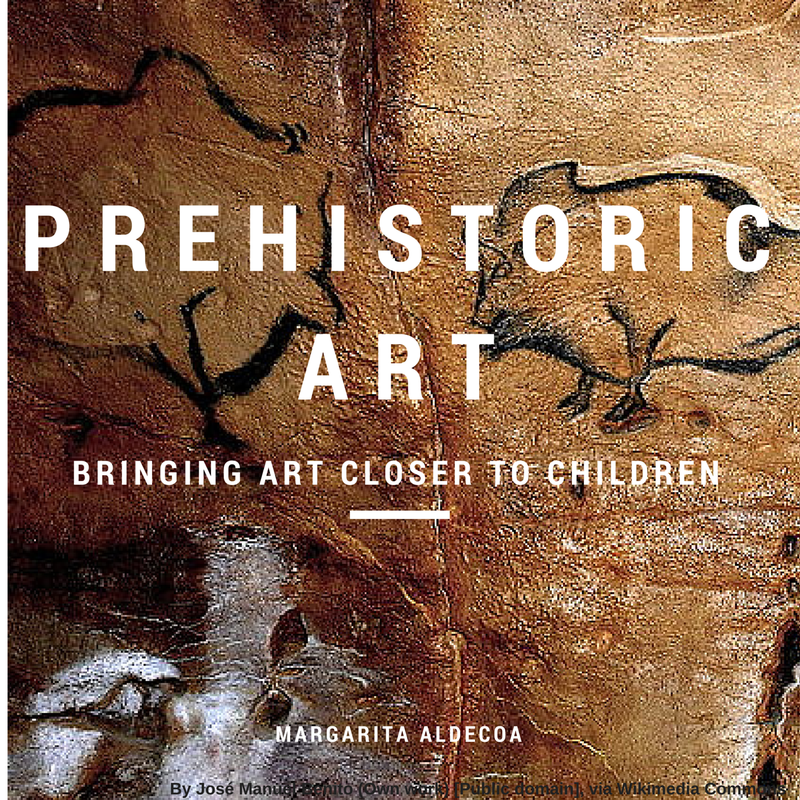
 @teacher_marga is a Primary Bilingual teacher who has just successfully completed her Master's Degree Module on The Use of ICT and Web Resources for Primary Bilingual Education at University Rey Juan Carlos in Madrid.

The result of the digital learning missions and challenges she has overcome along this three-month adventure is an e-publication aimed at CLIL Primary learners to interpret Prehistoric Art, entitled Bringing arts closer to children.

After evaluating other ebooks, reflecting on visual design principles, learning about licencing, citing and attributing; crafting audio and video challenges, designing flyers, attending live international events for inspiration and contributing to several international collaborative projects, @teacher_marga is showcasing all her findings in a blog where she offers tips and ideas for other CLIL Primary teachers to apply in lessons.

Check her proposals, tools and dreams, and listen to her own reflection after having cruised around CLIL digital teaching and learning for a while:


Create a Copy | View Larger


1 June 2015

Animals, animals, Animals!


Check the brand new e-publication for CLIL Primary learners by @asersantos.

Aser is a Primary Bilingual teacher who has just successfully completed his Master's Degree Module on The Use of ICT and Web Resources for Primary Bilingual Education at University Rey Juan Carlos in Madrid.


Along this three-month Master's Degree Module Aser has risen to various challenges and accomplished a wide range of learning missions until producing his final digital artifact: an e-publication ready to surf by anybody interested in CLIL teaching and learning.

Inspired by The ePerfect Textbook EVO session held back in October 2014, and challenged to brainstorm about facing lessons without textbooks, the first stage Aser has climbed up has been evaluating other e-publications, assessing their visual principles and drafting his own e-publication skeleton and mindmap.


Meanwhile, he has been curating resources and gatheting material so as to have everything ready when diving into designing the epublication itself, for whose showcase he has gone for Google Sites, and at the same time he has found about the importance of licencing, attributing and citing.


Of course, being an innovative young teacher, Aser could not miss the chance to be a connected educator, and he soon started twittering around and sharing with other peer teachers at virtual events such as the Spring Blog Festival and Moodle MOOC 6, both hosted by Dr. Nellie Deutsch, the collaborative #twima2 writing project, the InfoEdugrafias blogging project, or the Student Blogging Challenge mentorship. All these initiatives gave Aser the chance to be aware of the latest educational trends and put them into practice in his e-publication.


Inspired by all the above and encouraged by the proposal of missions available at the University Virtual Campus, Aser dived into e-publishing and crafting his own challenges for young CLIL learners and so now he is offering all kinds of learning adventures: from augmented digital mysteries to unveil when scanning images with Aurasma, online storyboards that lead to video productions, to audio challenges; all aimed at helping 8-year-old CLIL kids to learn about animals while having fun and improving their digital, language and science skills.

And, if you would like to meet Aser, there you are his own personal introduction and how to contact him too, although I would recommend you to go for the augmented version of this promising young CLIL teacher, which you will find on the left hand side of the 'Animals, animals, Animals' landing page.

However, if what you are wondering about is how Aser has lived this learning experience, do not hesitate to view and listen to his own reflections about this cruise: